Introduction
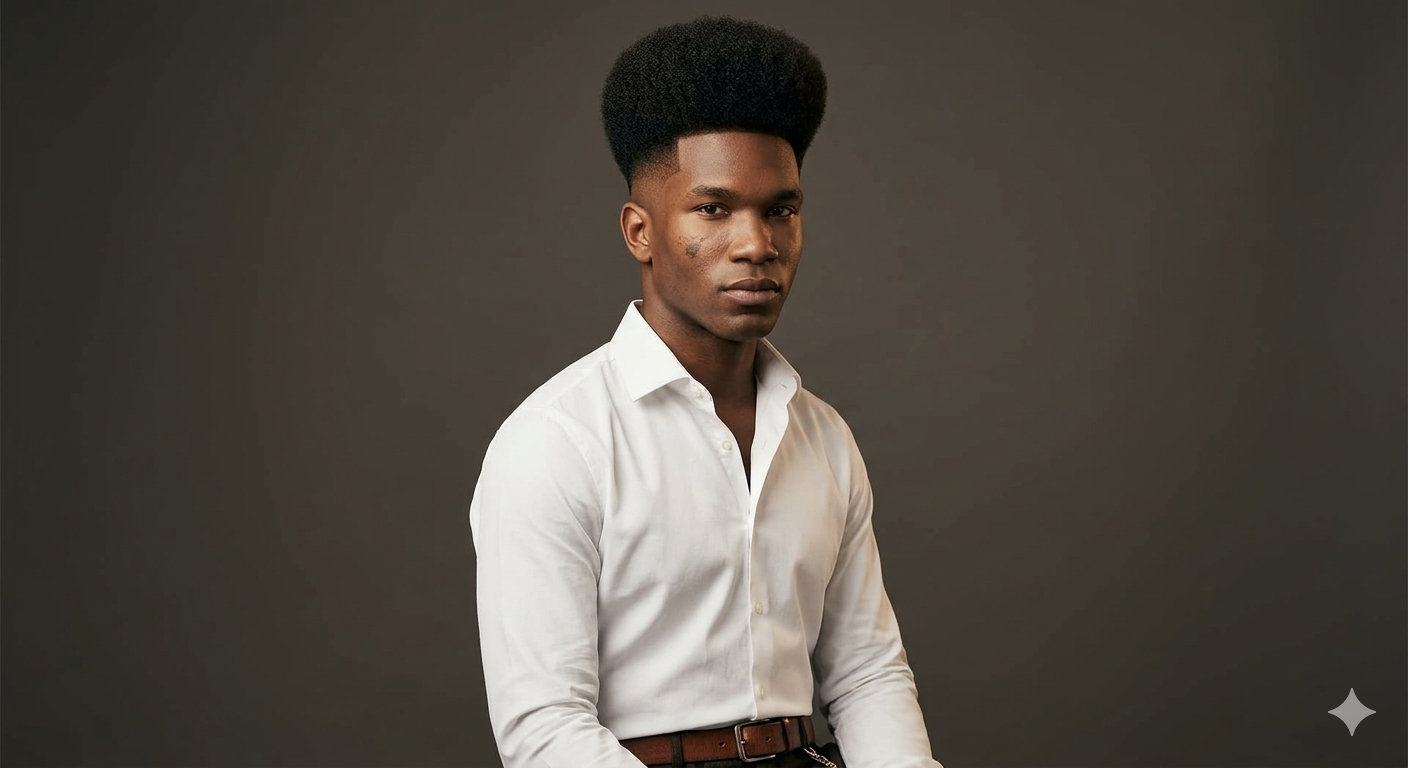
There is something profoundly powerful about an afro fade haircut. It is a style that carries history, celebrates identity, and achieves a visual dynamism that few other combinations in men’s grooming can match. The meeting of natural afro texture — voluminous, sculptural, deeply personal — with the precision of a fade creates a silhouette of extraordinary contrast and contemporary elegance.
Afro fade haircuts for men have moved decisively beyond subculture into the mainstream of global men’s fashion. They appear on the pages of the most prestigious style publications, on the heads of some of the most recognised figures in music, sport, and creative culture, and in the portfolios of the world’s most celebrated barbers. They are, without question, among the most visually compelling hairstyles available today.
In this guide, we explore 14 of the most exceptional afro fade haircuts for men — each one a distinctive expression of the form’s extraordinary range. Whether your natural texture is a tight coil, a loose curl, or somewhere between, there is a style here that will celebrate your hair’s natural character while showcasing the technical brilliance of a truly skilled fade. Each style is accompanied by expert guidance to help you achieve and maintain it at its very best.
1. The High Skin Fade Afro
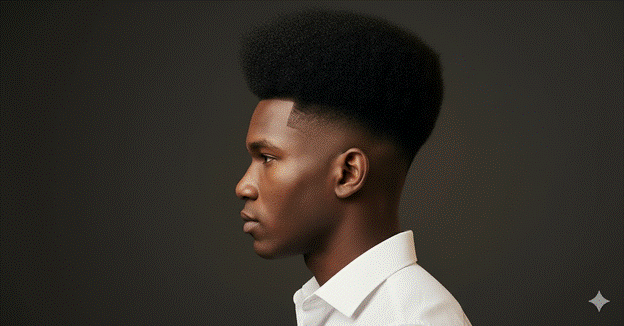
The high skin fade afro is the boldest and most architecturally dramatic expression of the style — a complete shave to bare skin beginning at the temples and ascending in a clean, uninterrupted gradient to the point where the natural afro texture begins its full, unrestricted expression. The contrast between the bare scalp and the richly textured afro above creates a silhouette of extraordinary visual power.
The height of the fade line — sitting above the temples, often at or near the level of the upper ear — creates an almost sculptural relationship between the clean lower section and the organic volume above. The afro itself, growing freely from the high fade line, has a presence that commands attention from across a room.
This is a style that works best on men with healthy, well-moisturised natural hair that has been shaped into a clean, even sphere or close to it. The fade’s precision and the afro’s volume exist in a visual dialogue that elevates both elements — each making the other more impressive by contrast.
Styling Tip: Ask your barber for a zero-to-skin taper beginning high at the temple, with the graduation point sitting at approximately the top of the ear. To maintain the afro’s shape between barber visits, use a wide-tooth comb or pick to lift and even the curl pattern daily, and apply a lightweight curl moisturiser to preserve definition and prevent dryness at the hair’s tips.
2. The Low Taper Afro Fade
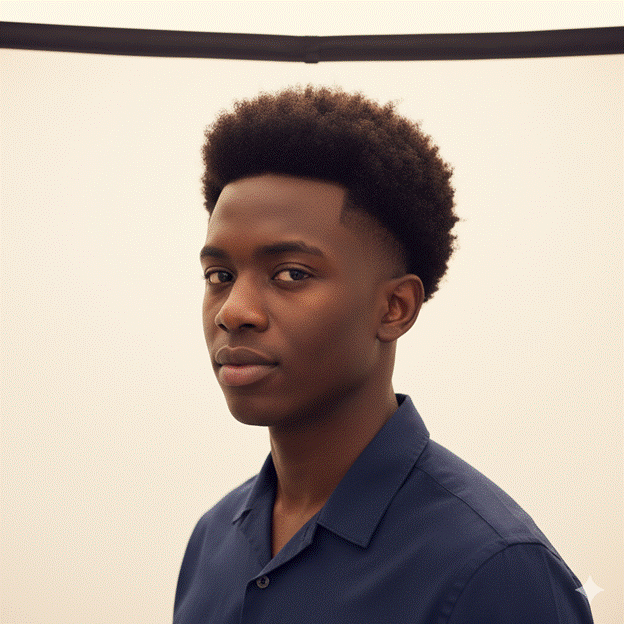
The low taper afro fade is the most refined and versatile member of the afro fade family — a style that delivers all the definition and clean precision of a fade while maintaining a more conservative, universally appropriate silhouette. The taper begins low at the nape and temple, rising only slightly before merging with the natural hair above, creating a subtle graduation that enhances the afro’s volume without theatrical contrast.
This is the afro fade for the man who moves between professional and social contexts and requires a hairstyle that serves equally well in both. Its restraint is its versatility — the low taper never reads as too casual for a boardroom nor too formal for a weekend gathering. It is a style of considered, understated elegance.
The low taper also suits men who are growing their natural hair and want to maintain a neat, professional appearance throughout the growth process. Its forgiving graduation means that it retains its character for longer between barbershop visits than the more dramatic high and mid fades.
Styling Tip: For the most natural-looking low taper, request a scissor finish on the lower section rather than a purely clipper-driven taper. The scissor graduation creates a softer, more organic transition that complements the natural texture of the afro above with particular elegance. Visit your barber every four weeks to maintain the taper’s clean lower edge.
3. The Mid Fade Afro
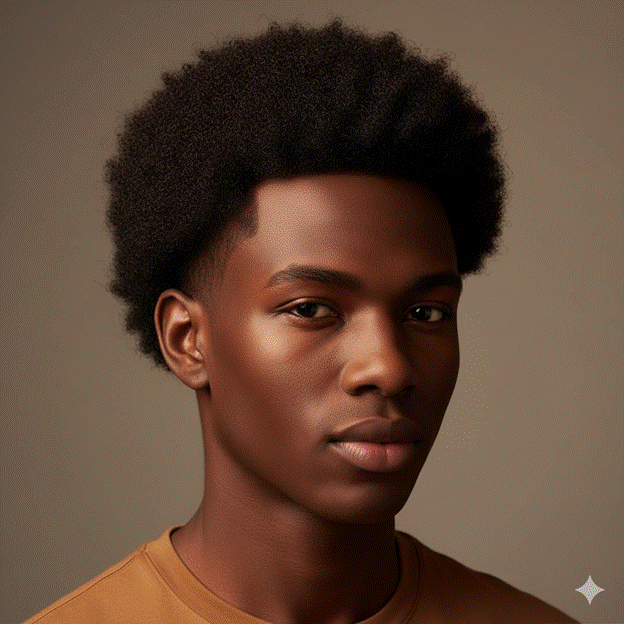
The mid fade afro occupies the most balanced position in the afro fade spectrum — positioned halfway between the conservative low taper and the dramatic high skin fade, it delivers a compelling contrast between the faded section and the natural hair above without the full theatrical commitment of the high style. It is the sweet spot of the form: clean, impactful, and broadly flattering.
The fade line at mid-height — typically level with the middle of the ear — creates a generous canvas for the afro above while providing enough faded section to showcase the technical precision of the graduation. The resulting silhouette has a balanced, symmetrical quality that suits a wide range of face shapes and head profiles.
The mid fade is the most commonly requested afro fade variation for precisely this reason — it resolves the tension between visual impact and daily versatility with the most satisfying consistency. It is the reliable choice, which is to say it is rarely the wrong one.
Styling Tip: When discussing a mid fade with your barber, specify the fade line height precisely by pointing to the desired starting point on your own head rather than relying on verbal description alone. What one barber considers ‘mid’ may differ from another’s interpretation. A fade that begins at the mid-ear will look different from one that begins at the ear’s top, and both are technically ‘mid.’
4. The Burst Fade Afro
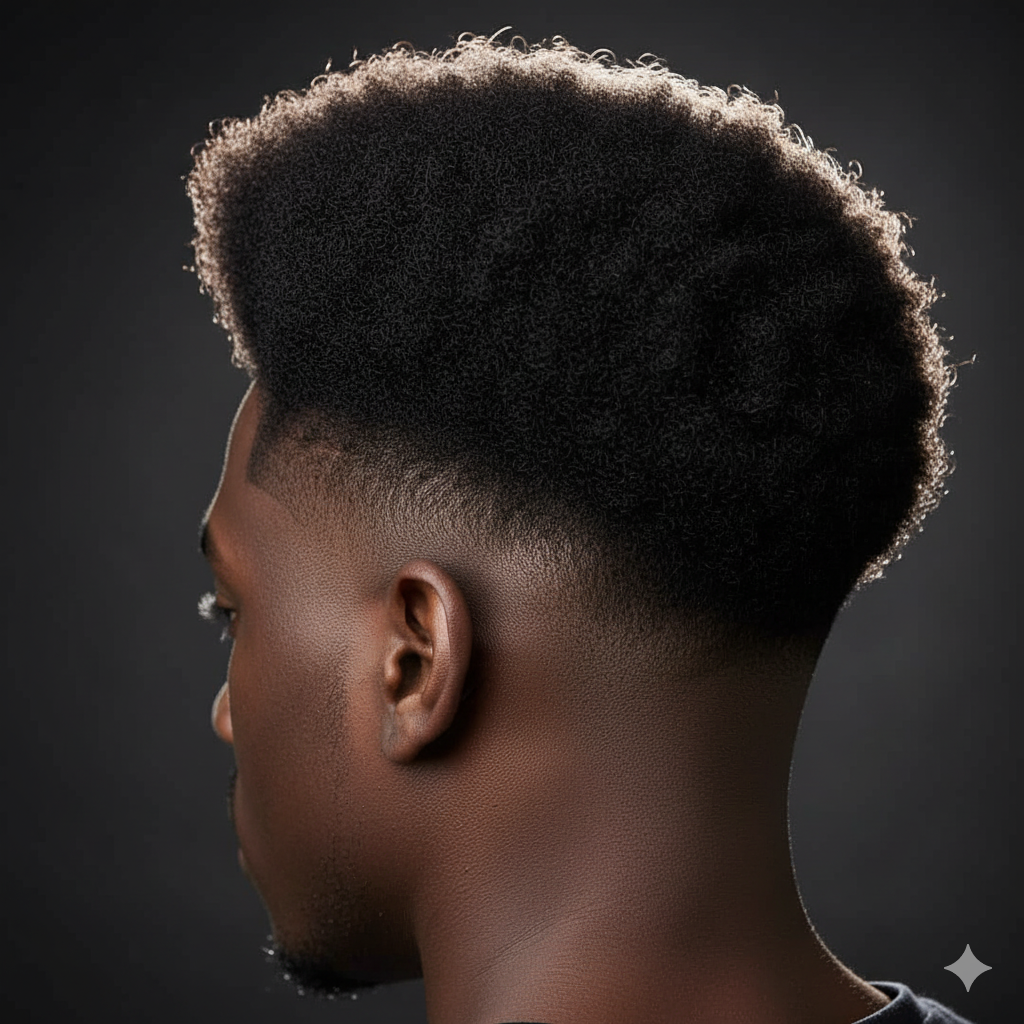
The burst fade is one of the most visually distinctive and technically demanding variations in the afro fade canon — a fade that radiates outward from behind the ear in a semicircular arc, creating a halo-like shape that frames the head with remarkable visual dynamism. Unlike the conventional taper that proceeds in a horizontal band around the head, the burst fade moves in a curve, following the ear’s shape and creating a unique dimensional quality.
When combined with a natural afro on top, the burst fade creates a composition of organic shapes — the circular afro volume, the curved burst graduation, the rounded ear — that feels entirely harmonious and possesses an artful, almost sculptural quality. It is a style that rewards close inspection, revealing its technical complexity gradually.
The burst fade suits men who want a style with clear design intention but who prefer its expression through shape and gradient rather than graphic lines and hard parts. It has a warmth and roundness that the more angular disconnected or lined styles lack, making it particularly flattering on faces where softness is a desired quality.
Styling Tip: The burst fade requires a barber with specific technical experience in the radial graduation technique. When seeking a barber, look for portfolio examples of burst fades specifically — the execution varies considerably between practitioners, and the most beautiful versions are the product of significant practice and genuine skill. Refresh the burst every two to three weeks to maintain the arc’s precision.
5. The Temple Fade Afro
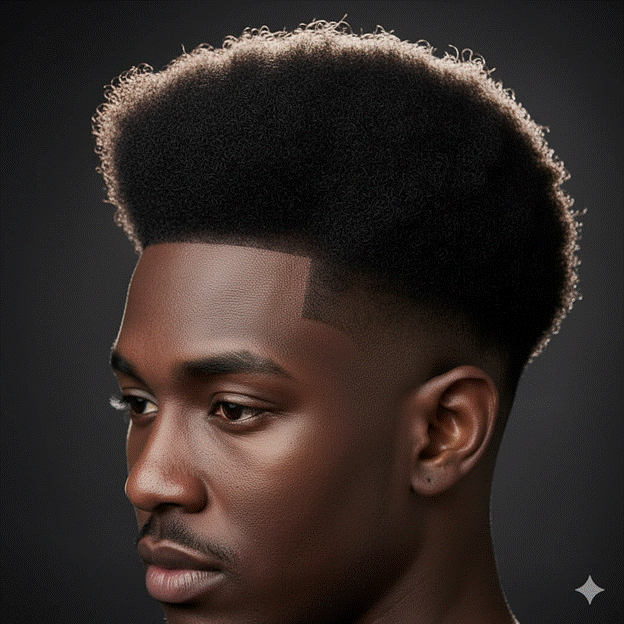
The temple fade — sometimes called a Brooklyn fade or a temp fade — is a precise, targeted fade applied specifically to the temple and sideburn area, leaving the hair above and behind relatively full while creating a clean, defined line at the most visible and frame-defining part of the hairline. For the afro fade, this focused approach creates a beautifully precise edge while allowing the natural hair above to grow with full freedom.
The temple fade’s particular contribution to the afro is the definition of the hairline frame. The clean, sculpted temple creates a visual structure around the face — especially the forehead and cheekbone area — that makes the afro above feel intentional and shaped rather than merely grown. It is the grooming equivalent of framing a painting: the art was already beautiful, but the frame completes it.
This is the ideal style for men who want to maintain the full natural volume and freedom of their afro while adding the precision and definition that a clean hairline provides. It is also the most approachable entry point into the afro fade world for men trying the style for the first time.
Styling Tip: The temple fade’s defining element is the precision of the hairline edge at the forehead and sideburn. Request that your barber use a straight razor or detail trimmer to create a clean, crisp line rather than a soft, blended one — the sharpness of this edge is what gives the temple fade its distinctive character and its powerful impact on the face’s overall framing.
6. The Afro Fade with Hard Part
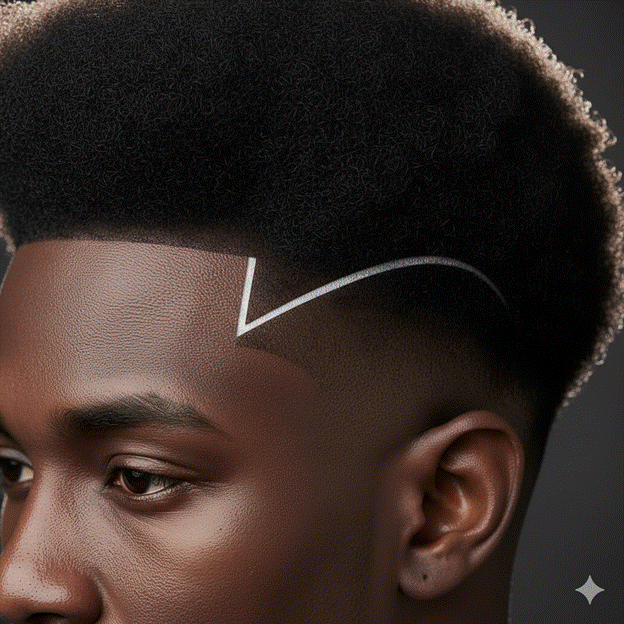
The hard part — a razor-shaved line of geometric precision carved directly into the scalp — adds a graphic design dimension to the afro fade that transforms the style from an organic form into something that also carries strong architectural intention. The sharp white line of the shaved part against the rich darkness of the natural hair is visually arresting in a way that few design elements can achieve.
In combination with an afro fade, the hard part typically runs from the front hairline back toward the crown on one side, creating a defined separation between the swept afro volume and the faded section below. It anchors the style’s composition with a geometric certainty that prevents any ambiguity about where the eye should travel and how the silhouette should read.
The hard part suits men whose personal style tends toward the precise and the deliberate — men who appreciate the language of clean geometry in their broader aesthetic choices and who understand that a well-placed line can be as expressive as any other design gesture.
Styling Tip: Maintain the hard part’s sharpness by visiting your barber every two weeks specifically for a line-up and part refresh, even if the fade itself doesn’t yet require attention. A sharp hard part on a slightly grown-out fade looks intentional; a grown-out part on a fresh fade undermines the entire composition. The line’s precision is the style’s visual argument — protect it consistently.
7. The Box Fade Afro
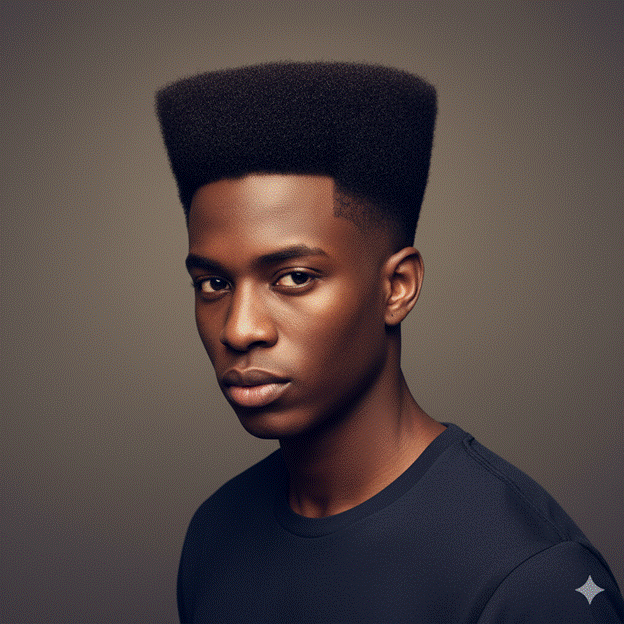
The box fade afro is a style with deep roots in African-American barbering culture — a form that achieves its distinctive silhouette through the combination of a precise fade on the sides and back with an afro shaped into a geometrically clean box: flat on top, straight on the sides, and defined at the corners with an evenness that reads as deliberate and architecturally considered.
The box shape transforms the natural afro from an organic sphere into a geometric form of considerable visual authority. Its flat top and straight sides create a profile reminiscent of the iconic flat-top haircut but executed entirely through natural curl texture — no chemical straightening, no hard product application, simply the skilled shaping of natural hair into an intentional form.
The box fade afro is a style that carries significant cultural resonance while remaining entirely contemporary in its visual impact. It is as at home in a fashion editorial as it is in the barbershop portfolios of the most celebrated natural hair craftspeople working today.
Styling Tip: The box shape requires regular maintenance of its top and side lines — the flat top begins to lose its geometric clarity within two to three weeks as the natural hair grows upward and outward. Keep a pair of grooming scissors or a detail trimmer for light at-home touch-ups between barbershop visits, focusing on maintaining the corner definition that gives the box its characteristic graphic quality.
8. The Afro Fade with Design
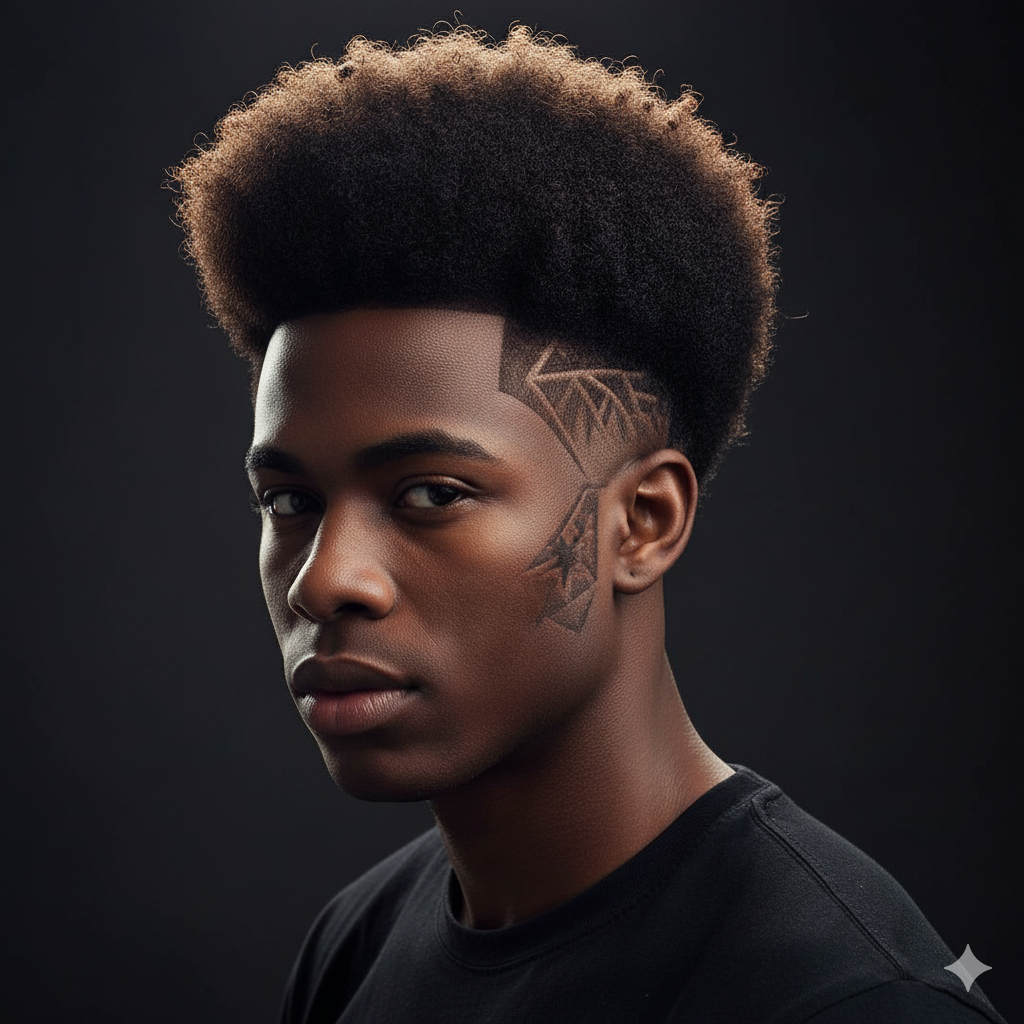
The afro fade with shaved design is the most expressive and individualistic interpretation of the style — a combination that treats the faded section as a canvas for geometric or organic pattern work. Lines, curves, geometric shapes, and even complex pictorial designs carved into the closely faded hair create a hairstyle that is as much a work of personal art as it is a grooming choice.
The natural richness of afro texture above provides a dramatic textural contrast to the shaved design below — the depth and complexity of the natural curl pattern against the clean precision of the carved lines creates a visual tension that is entirely unique to this style. No other hair type produces quite the same effect.
The afro fade with design is worn by men who understand their hairstyle as a form of self-expression and who want that expression to be visible, specific, and unmistakable. It is a style that invites conversation, communicates personality, and rewards the close attention it inevitably attracts.
Styling Tip: Commission your barber to design a pattern that has genuine personal significance rather than simply choosing a geometric shape for its visual appeal. A design with meaning will always be worn with more conviction than one chosen arbitrarily — and conviction, in a bold hairstyle, is always the most important styling product. Bring visual references and be specific about scale, placement, and the relationship between the design and the fade gradient.
9. The Drop Fade Afro
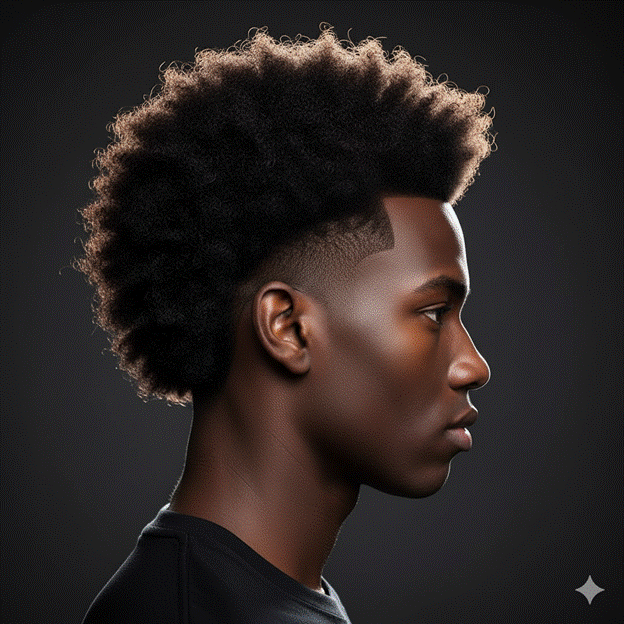
The drop fade is distinguished by a fade line that arcs downward behind the ear rather than running horizontally around the head — dropping toward the nape in a curved trajectory that creates a dramatically different silhouette from the conventional horizontal fade. When applied to the afro fade, this curved line adds a sense of movement and visual sophistication that the straight horizontal fade does not possess.
The drop creates a more generous faded area at the sides and temple while allowing the hair behind the ear and above the nape to remain longer, adding to the naturalness of the rear silhouette. Viewed from the side, the arcing fade line has an elegant, almost calligraphic quality — a single curved line that organises the entire composition of the style.
The drop fade suits men with longer head profiles and those who prefer a more organic, less geometric overall silhouette. Its curved line is more relaxed in character than the hard horizontal of the standard taper, giving the style a contemporary refinement that feels thoroughly modern.
Styling Tip: The drop fade’s beauty is entirely dependent on the precision and smoothness of the arc. An inconsistent or asymmetrical drop undermines the style’s defining quality. When evaluating your barber’s work, use two mirrors to check the symmetry of the drop from both sides simultaneously — a well-executed drop fade should mirror itself exactly on both sides of the head.
10. The Afro Taper with Line Up
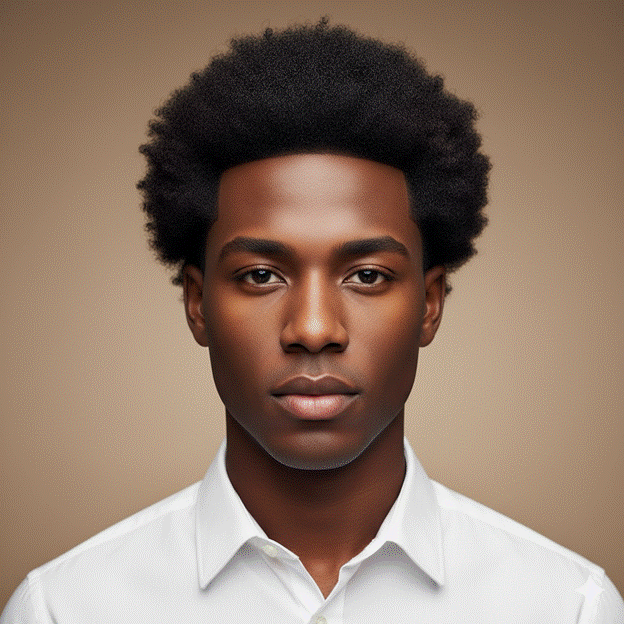
The afro taper with line up combines the subtle graduation of a taper with the defining precision of a razor-sharp hairline — the clean, geometric edge created along the forehead, temple, and nape that frames the face and neck with authoritative clarity. It is a style of composed, deliberate elegance that achieves maximum definition through minimum fade drama.
The line up is the element that makes the difference in this style — the sharp right angles at the forehead corners, the clean straight edge along the hairline, and the precise definition at the sideburn create a structural frame for the afro above that is immediately visible and consistently impressive. It communicates that the wearer attends to the details of his presentation with genuine care.
This is the most professional and formally appropriate afro fade style in this collection — the combination of a conservative taper with a clean line up reads as impeccably groomed in virtually any context, from the most creative environments to the most formally conservative.
Styling Tip: The line up’s geometric precision requires the sharpest possible tool — a detail trimmer with a precise blade or a straight razor held at exactly 90 degrees to the skin creates the cleanest, most defined edge. Request that your barber spend additional time on the forehead corners, where the line transitions from vertical to horizontal — this is the technically most demanding point of the line up and the most visible indicator of the barber’s precision.
11. The Short Afro Fade
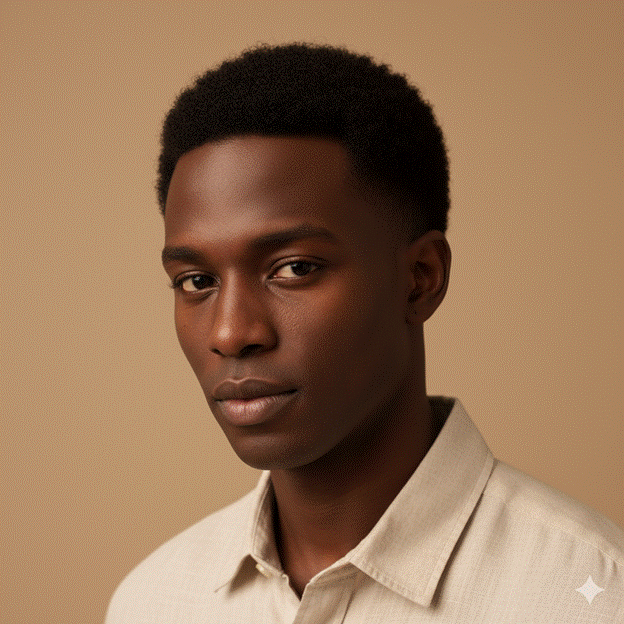
The short afro fade keeps the natural hair close to the scalp — typically no more than one to two inches at the crown — creating a clean, compact, and supremely low-maintenance expression of the afro fade aesthetic. The tighter the curl pattern, the more sculptural and densely textured the short afro appears, giving the style a visual richness that belies its modest length.
The short afro fade is one of the most universally flattering hairstyles available — its close length works with virtually every face shape, head profile, and hair texture, and its minimal styling demands make it the most practical option for men whose lives do not permit the time investment of longer natural styles.
This is the style for the man who wants to celebrate his natural texture with a clean, contemporary presentation — one who understands that brevity in length does not mean brevity in character, and that a well-executed short afro with a precise fade is as impactful in its own register as any longer style.
Styling Tip: A leave-in moisturiser or curl cream applied to the short afro daily keeps the natural texture hydrated, defined, and visually vibrant. The most common mistake in maintaining a short afro is neglecting moisture — dry, tight curls lose their natural lustre and begin to look dull rather than richly textured. Moisturise consistently and your short afro will always look freshly styled.
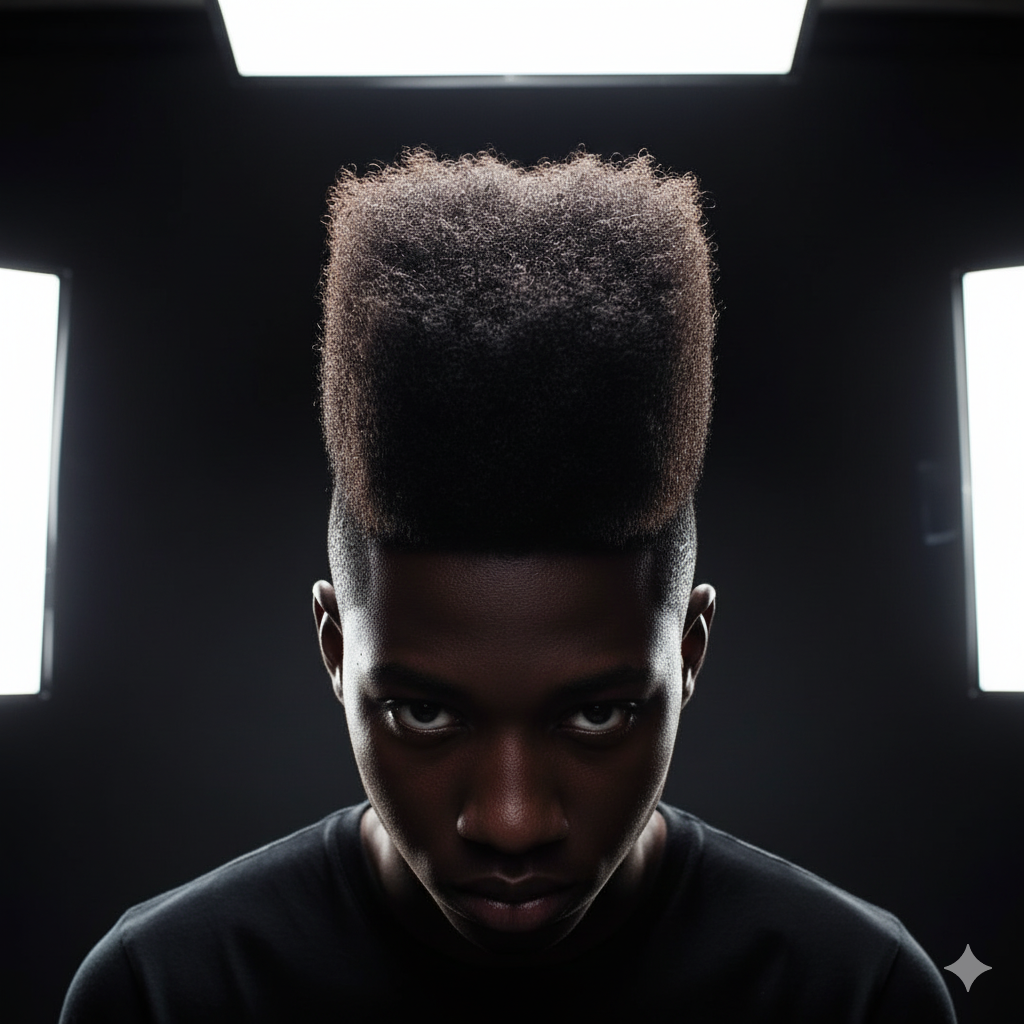
12. The Afro Mohawk Fade
The afro mohawk fade is an extraordinary convergence of two distinctly powerful aesthetic traditions — the mohawk’s central strip of elevated hair and the natural afro’s richly textured volume — unified by a precise fade that ties the composition together with contemporary barbering precision. The result is one of the most visually dramatic hairstyles in men’s grooming.
The natural texture of the afro mohawk is what distinguishes it from its straight-haired equivalent. Where the conventional mohawk relies on product and gravity defiance to create its central strip, the afro mohawk achieves its height and density through the inherent properties of natural curl — the hair rises organically, sustains its own volume, and presents a surface of extraordinary textural complexity.
The sides are faded to the skin or very close to it, creating the maximum possible contrast with the rich texture of the central strip above. The transition from bare skin to dense natural curl is among the most visually compelling contrasts available in contemporary men’s hairstyling.
Styling Tip: Define the width of the mohawk strip before your barber begins the fade — the proportion of the central strip to the faded sides determines the style’s overall character. A wider strip reads as more relaxed and wearable; a narrower strip creates a more dramatic, fashion-forward impression. Most men find a strip width of approximately two finger-widths above the ear on each side the most flattering proportion for daily wear.
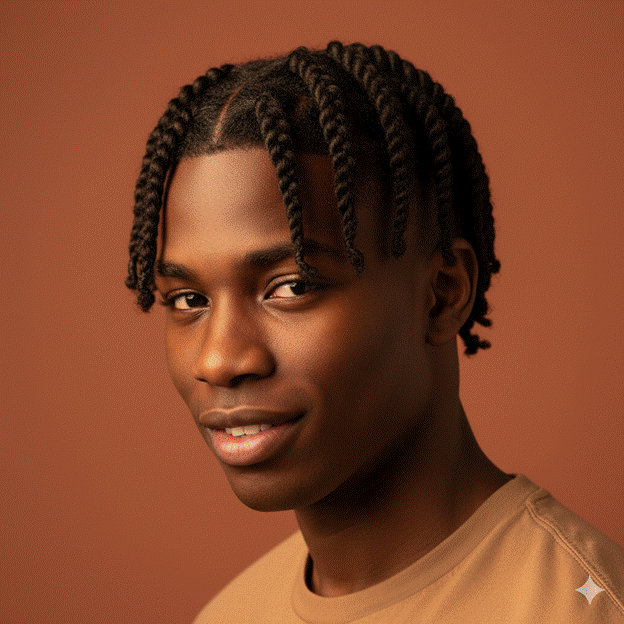
13. The Afro Fade with Twists
The afro fade with twists brings an additional layer of natural hair texture to the afro fade combination — the twisted sections of the top providing a defined, rope-like texture that contrasts beautifully with the smooth gradient of the faded sides. Two-strand twists, flat twists, or mini twists all create different textural effects above the fade, offering a wide range of aesthetic expression within a single fundamental style concept.
The twists serve simultaneously as a protective style and a design element — they reduce daily manipulation of the natural hair, protect the ends from environmental damage, and create a structured, intentional surface that the loose afro does not possess. The result is a style that is both beneficial for long-term hair health and immediately compelling in its visual presentation.
The colour of the twists can add further dimension to this style — a subtle tint at the tips, a contrast colour on selected twists, or a fade into a lighter tone at the ends creates a colour story that elevates the entire composition from a study in texture to one in both texture and colour.
Styling Tip: Maintain the twists’ definition by applying a twist butter or cream to each twist every two to three days, re-twisting any sections that have begun to unravel. Sleep with a satin bonnet or on a satin pillowcase to preserve both the twist pattern and the fade’s precision overnight — friction against cotton pillowcases is the most common cause of premature twist unravelling and fade disruption.
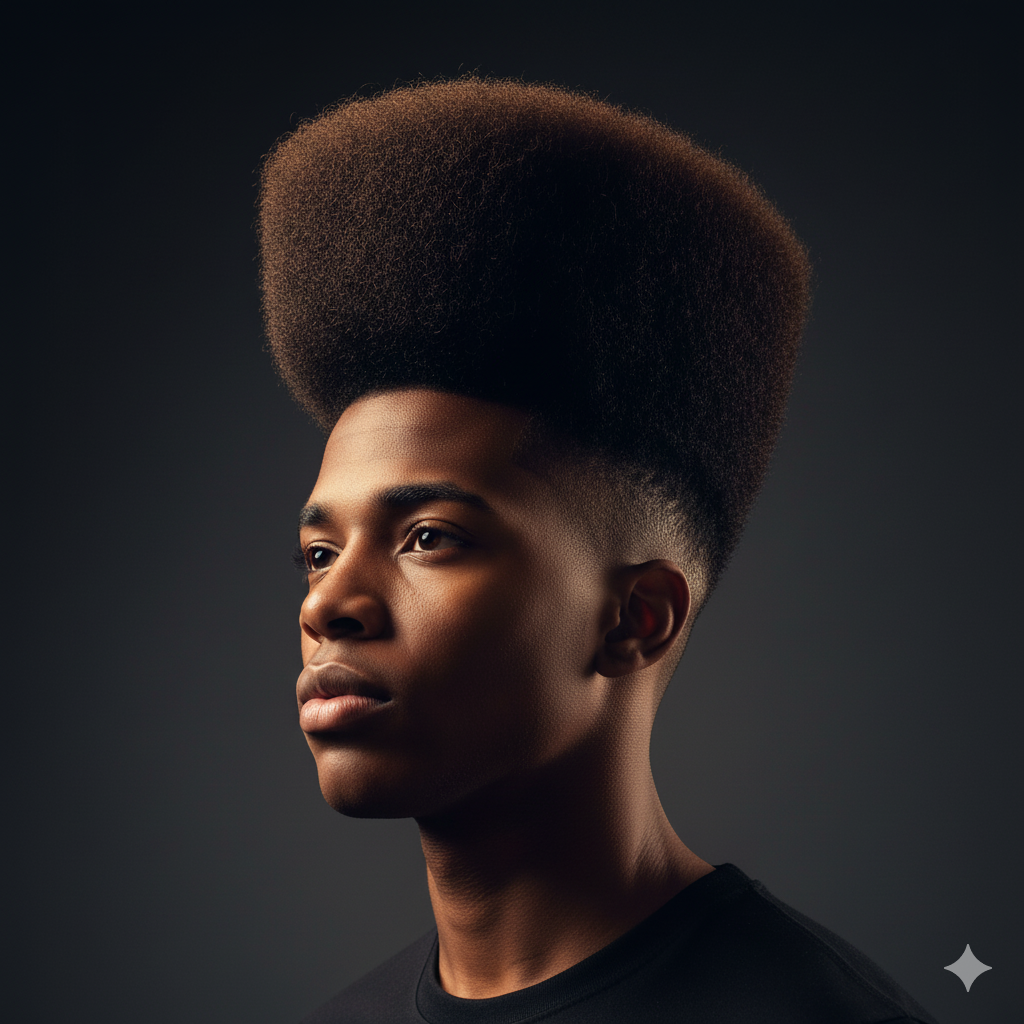
14. The High Top Fade Afro
The high top fade afro is a style of genuine historical significance and enduring contemporary relevance — one of the most celebrated forms in the entire canon of Black men’s hairstyling, reinvented by successive generations and remaining as visually powerful today as when it first captured the cultural imagination of the late 1980s and early 1990s. It is a hairstyle that carries the weight of its history gracefully, never feeling dated because its fundamental form is simply too strong to become irrelevant.
The high top creates its distinctive silhouette through the combination of a dramatic flat top — the hair at the crown shaped into a perfectly level, elevated surface standing well above the head — with a skin fade or close taper on the sides and back. The height of the top section, which can range from two to four or more inches, determines the style’s overall drama, with taller versions making the most commanding visual statements.
In its current iteration, the high top fade afro is worn with equal enthusiasm by men who cherish its cultural heritage and those who are simply drawn to its extraordinary visual power. It is a style with a community around it and a story within it — wearing it is to participate in a living aesthetic tradition.
Styling Tip: The flat top’s defining characteristic is the geometric precision of its level upper surface. Maintain this at home between barbershop visits using a flat top comb — a wide-toothed comb with a flat, level spine that guides the trimmer in a perfectly horizontal plane. Practiced carefully, this technique can extend the flat top’s clean shape by an additional one to two weeks between professional appointments.
Conclusion
Afro fade haircuts for men represent one of the most creatively rich and culturally resonant territories in the entire landscape of contemporary men’s grooming. They celebrate natural texture not as a starting condition to be managed but as the defining material of a hairstyle’s beauty — the element that makes the visual composition possible and the element that makes it personal.
The 14 styles explored in this guide demonstrate the extraordinary range of expression available within the afro fade concept. From the understated refinement of the low taper to the architectural boldness of the high top, from the geometric precision of the hard part to the organic artistry of the burst fade — each style offers a different way of celebrating the same fundamental truth: that natural afro texture, paired with skilled fade work, produces some of the most beautiful hairstyles in the world.
Find the style that resonates with your aesthetic vision, your lifestyle, and your natural hair’s character. Invest in a barber who understands both the technical demands of the fade and the specific properties of your curl pattern. And wear your chosen style with the grounded confidence that comes from knowing your hair is both beautifully groomed and authentically, proudly your own.
Frequently Asked Questions
Q1. What is the difference between an afro fade and a regular fade?
The fundamental difference is the texture of the hair above the fade line. A regular fade is typically applied beneath straight or wavy hair that flows smoothly from the faded section. An afro fade creates a dramatic textural contrast between the smooth, graduated fade below and the richly dense, three-dimensional natural curl texture above. This contrast — between the bare precision of the fade and the organic complexity of the afro — is what gives afro fade haircuts their distinctive and particularly powerful visual character.
Q2. How often should you get an afro fade touched up?
The frequency depends on the fade type and how quickly your hair grows. High skin fades and line-up styles require the most frequent attention — typically every one to two weeks — to maintain their defining precision. Mid fades can be maintained every two to three weeks. Low tapers are the most forgiving, often retaining their character for three to four weeks. The afro itself, if kept moisturised and picked daily, can maintain its shape between fade visits. Establish a maintenance schedule with your barber at your first appointment.
Q3. What products are best for maintaining an afro fade?
A leave-in moisturiser or curl cream applied daily to the afro section keeps natural curls hydrated, defined, and visually vibrant. A lightweight oil — such as jojoba or argan — applied to the scalp and hair two to three times weekly prevents the dryness that tightly faded sections are particularly susceptible to. For styled variations such as the box fade or afro with twists, a twist butter or shea-based styling cream maintains definition between styling sessions. Avoid heavy petroleum-based products that build up on the scalp and dull the natural texture.
Q4. Do afro fade haircuts work for all curl types?
Yes, with appropriate customisation. The fade element of the style works regardless of curl pattern — the taper and graduation techniques are the same for all hair types. The afro above the fade will look different depending on whether the natural texture is a loose type 3 curl or a tight type 4 coil, but both produce beautiful results. Tighter curl patterns tend to produce the most dramatic contrast with a skin fade, while looser curl patterns create a more gradual textural transition from the faded section. Discuss your specific curl type with your barber to determine the most flattering fade height and graduation style for your particular texture.
Q5. Can afro fade haircuts be worn in professional environments?
Absolutely. Styles such as the low taper afro, the afro taper with line up, the short afro fade, and the mid fade afro are entirely appropriate in professional environments of all kinds, including conservative corporate settings. The key factors are cleanliness, maintenance precision, and the overall scale of the style — a well-maintained, precisely lined afro fade in a conservative length communicates the same grooming standards as any other professional hairstyle. More dramatic variations such as the high top fade, afro mohawk, or afro with shaved design are best suited to creative industries or occasions where expressive personal style is welcomed.